
Software for the quantum age
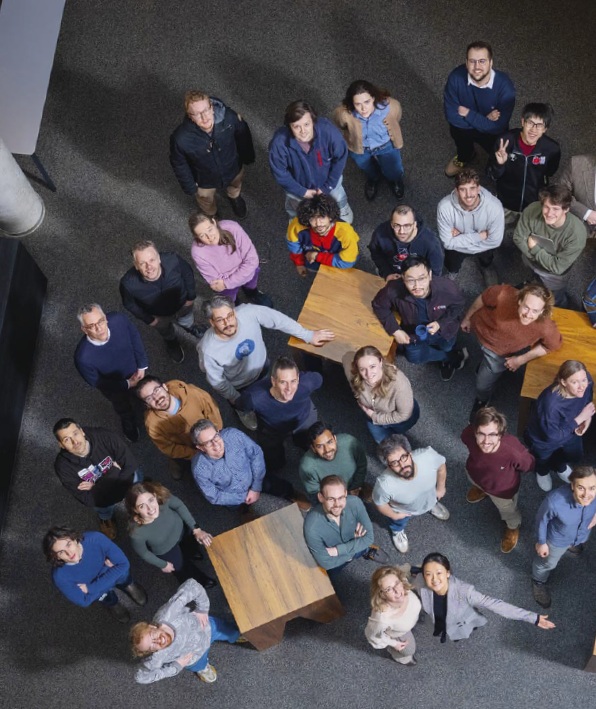
At QuSoft, the Research Centre for Quantum Software, about one hundred researchers are developing quantum software that will turn the future quantum computer into a practical problem solver. This year, the organisation is celebrating its tenth anniversary.
Following the inception of the quantum computer in the 1980s, its first few decades of development focused primarily on the hardware. However, quantum hardware can only solve practical problems if it is equipped with suitable quantum software. QuSoft at the Amsterdam Science Park is the world’s first quantum software research centre, founded in December 2015 by Centrum Wiskunde & Informatica (CWI) and the University of Amsterdam (UvA).
‘In ten years, we have become a national and international centre for quantum software,’ says Christian Schaffner, director of QuSoft and Professor of Theoretical Computer Science at UvA. ‘In terms of size, with some hundred researchers, and with our strong focus on mathematics and computer science, we are unique in the world.
’Over the past decade, QuSoft has produced approximately 30 PhD students and 14 postdocs, who are all prepared for the age of the quantum computer. Among the many research highlights, QuSoft researcher Ronald de Wolf (CWI, UvA) and his co-authors received the Gödel Prize 2023 for their outstanding publication in theoretical computer science. This makes De Wolf the only Dutch person ever to have won this prestigious computer science prize.
Another highlight is the establishment of a new and worldwide unique master’s programme in Quantum Computer Science at the UvA. Schaffner: ‘If quantum computers really take off, there will be a shortage of experts. We want to respond to that now. Currently, we are in the second year of our master’s programme Quantum Computer Science. In the first year, we had nine firstyear students; this year we already have 27; and we hope to grow to 50 new first-year students in the coming years.’ One of the important developments in the coming years is the construction of LabQ, a new building at Amsterdam Science Park, planned to be ready by the end of 2028. This lab will bring together Amsterdam-based education, research, and valorisation in the fields of quantum physics, quantum computing, and quantum technology.
‘Bringing all of this quantum knowledge together in one buil- ding will provide an extra boost for our ecosystem’, Schaffner says. ‘The recently published National Technology Strategy and the Wennink report on the future earning capacity of the Netherlands have also identified quantum technology as one of the strategic opportunities in which the Netherlands excels.
If that leads to new research investments, we are prepared for it, partly because in the coming years we will be conducting more research into practical applications, such as quantum drug discovery.’
Quantum compiling
Research at QuSoft combines computer science with mathematics and physics. Approximately half of QuSoft’s researchers have a background in computer science. John van de Wetering, a senior researcher and assistant professor at UvA, has a background in all three disciplines, but his QuSoft research primarily falls within computer science. Van de Wetering: ‘I conduct research into quantum compiling. How do you translate a quantum calculation described in a high-level language into lowlevel instructions that the quantum computer can execute? I want to know how to do that in such a way that you can be sure that the compilation is done correctly.’
Both the problems they study at QuSoft, and their terminology and academic culture belong to computer science, says Van de Wetering. ‘We find ourselves in between mathematics, with its rigorous formality, and the more intuitive approach of physics.’
One of the reasons he applied for his current position was that Van de Wetering would become responsible for setting up the new master’s programme in Quantum Computer Science. ‘In addition to doing research, I was looking for a new challenge, and I found it in setting up a programme that did not exist anywhere else. I am now responsible for the scientific content of the programme and I teach two of our fifteen courses: Quantum Programming Project, in which students write opensource software for external partners, and Full-stack Quantum Computing, which is about quantum compiling and quantum error correction.’
Post-quantum cryptosystems
At CWI, fourth-year PhD student Lynn Engelberts works at the intersection of quantum algorithms and classical cryptography. ‘My research can be seen in the context of Shor’s famous quantum algorithm from 1994 for factoring large numbers’, Engelberts tells. ‘That algorithm shows that many current cryptosystems that are widely used in banking, for example, are not secure against attackers with large-scale quantum computers.
’A proposed solution is post-quantum cryptography, classical schemes that are – based on their mathematical properties – believed to be secure even if attackers use a quantum computer. To keep current applications secure, post-quantum cryptography is already gradually being introduced. Engelberts: ‘I am trying to understand whether such post-quantum cryptosystems really are secure against both classical and quantum attacks.’
After obtaining a joint bachelor’s degree from UvA and VU Amsterdam, and a master’s degree from the University of Oxford, Engelberts returned to Amsterdam to pursue her PhD. ‘I concluded that QuSoft and CWI are the best places for me. QuSoft has an excellent international reputation. I have just returned from an international conference where I noticed once again how easy it is to network: there is always someone who knows someone from QuSoft. We have a large group, with many young people and a lot of energy. And in addition to the quality of the research, there is also a strong focus on the human aspect.’
Group passport – Qusoft
Research fields
- Quantum simulation and few-qubit applications; quantum information science; cryptography in a quantum world; quantum algorithms and complexity; quantum for society and business
Institution
- Centrum Wiskunde & Informatica (CWI) and University of Amsterdam (UvA)
Employees: Total 120
- 38 permanent academic staff members, 8 postdocs, 30 PhD students, 35 MSc students, 9 support staffts.
Websites
Published in I/O Magazine #1 2026
Text Bennie Mols
Images Ivar Pel