
Trailblazer bringing structure
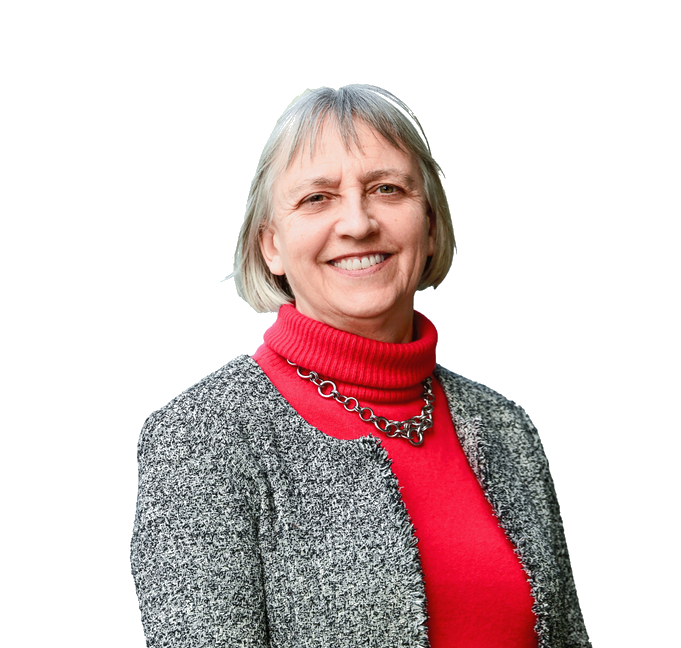
Lynda Hardman, Principal Research and Strategist at Centrum Wiskunde & Informatica (CWI) and Professor of Multimedia Discourse Interaction at Utrecht University, recently received the IPN Distinguished Service Award. Besides being a decades-long frontrunner in unlocking new ways to explore information, the computer scientist has been a transformative force for equity, diversity, and inclusion, both nationally and across Europe
How did you end up in informatics?
‘When in high school, my dream was to work at CERN, so I studied physics, mathematics and chemistry. But four years of studying physics knocked the love for the field out of me. To get an idea of what kind of career might suit me instead, I filled in a computer program (this was 1982!), which suggested I might enjoy a career in operations research. Initially I had no clue what that was, but it sounded interesting. I looked for a company that might sponsor my MSc and ended up as a computer programmer at International Computers Ltd., a large British computer manufacturer where I programmed printer drivers.’
How did you become an academic from there?
‘I had been at the company for about a year when they decided to close their premises in Edinburgh. Some of my previous colleagues launched a startup, and I joined that. At that company, Office workstations Ltd., I wrote software for the first Macintosh systems. That is when I first came into contact with interactive text – known as hypertext. I joined Heriott-Watt university as a research assistant to deep dive into the question of how to navigate hypertext. This allowed me to attend the first ever international hypertext conference in Chapel Hill in 1987, despite it being sold out. When I later met my husband in Edinburgh and wanted to move to the Netherlands, Office workstations Ltd. offered me the opportunity to work remotely on a joint project they had with the University of Amsterdam. They even rented a desk for me at CWI. It was that project that gave me the bug for research for real. A couple of months in, the company had to “let me go”. I worked for CWI on a couple of temporary contracts, but for me to get a permanent position at CWI, I had to have a PhD. That is what motivated me to obtain my PhD from the University of Amsterdam.’
What kinds of topics have you been working on over the years?
‘It all started with hypertext, which I was researching to create systems that help humans access information in an easy-to-navigate way. That became the theme of my research. My PhD thesis combined interactive text with images, audio and video. That work laid the foundations for SMIL (Synchronized Multimedia Integration Language) developed by the W3C working group. While SMIL as such is no longer supported, the underlying ideas are integrated into HTML5.
After my PhD I started working on semantics for films, based on how editors connect video segments so they tell a coherent story. At a certain point, I became increasingly concerned about how such technologies could potentially be used for automated propaganda, so I shifted towards data visualization from semantic modelling.
Over the past few years, I have for example worked on projects to visualize how many fish appear in undersea videos, and to navigate interlinked concepts in neuroscience. Our methods are not based on large language models or machine learning, but on connections between the concepts in publications. It’s always difficult to introduce novel technologies when they are very different from those users are already familiar with.’’
Lynda Hardman is a Principal Researcher and Strategist at Centrum Wiskunde & Informatica (CWI), the national research institute for mathematics and computer science in the Netherlands, and Professor of Multimedia Discourse Interaction at Utrecht University. She is the chair of the Surf WTR (Scientific and Technical Council) and of the COST Scientific Committee. Her research interests were in user-centric interaction design for exploring information in the context of developing technologies.

You have become widely known for your efforts to increase the amount of women in STEM. When did you decide to advocate for this topic?
‘Even though I had always been the only woman in a group of men, it had never bothered me that much. I was one of the guys, and thought that the “male” culture in computer science simply was the way it was. It was not until 2011 when I recognized that the culture of which I was a part was not good for attracting other women. By this time, I had joined the management team at CWI as the first woman (and the first foreigner). I requested a coach to help me in my new role. She was a passionate feminist who knew how the university culture operated. It felt like my sunglasses had been removed.
Around that time, the then director of CWI, Jan Karel Lenstra, sent me to represent CWI at the European Computer Science Summit organized by Informatics Europe, an organization I hadn’t heard of. Out of curiosity, I attended their board meeting, after which I was invited to join the board for dinner. One of the board members asked me: “Why don’t you join the board?” With two young children this was not high on my to-do list. However, at lunch the next day the executive director mentioned that “We need someone to help increase the number of women in our field.” I was sold! Being one of the very few women researchers at CWI, I could reach out to others in Europe.’
How did you fill in this role?
‘As part of Informatics Europe, I founded the WIRE (Women in Informatics Research and Education) working group. With this group, we issued a small booklet called “More Women in Informatics Research & Education” that provides practical guidance on how to attract and retain female talent. When Maarten van Steen became the president of IPN, he too pursued a cultural change. I helped him set up the statutes in such a way that they embedded diversity. I also founded the IPN Equity, Diversity and Inclusion (EDI) working group to make sure the topic would stay alive for the longer term. As a member of the working group, I co-edited another booklet called “Why would I want to do a PhD in Computer Science?”, in which (mostly) female doctors in Computer Science in different stages of their careers share their experiences.’
Have things changed over the years?
‘Slowly but surely, yes. A large boost was the decision that at least 35 percent of the new sector plan hires should be women. And top down initiatives like the LNHV (the Dutch network for women professors) monitor have been very useful in raising awareness. What’s troubling though is that most of the women in the Dutch computer science community are foreigners.
A major challenge starts in Dutch primary schools, where many girls disengage from STEM at an early age. We need to show them that computer science is a very creative sector: you are not studying what things are like, you are creating new things that don’t yet exist.’
In about 1,5 years you will be retiring. What do you hope to leave behind?
‘Structures. My legacy primarily consists of the IE WIRE (now broadened to other forms of diversity) and IPN EDI working groups. As a next step, I would like to help with introducing computer science to all schools in the Netherlands. This is a wicked problem, that I would love to help with in some way.’
Photo: Thijs ter Hart.