
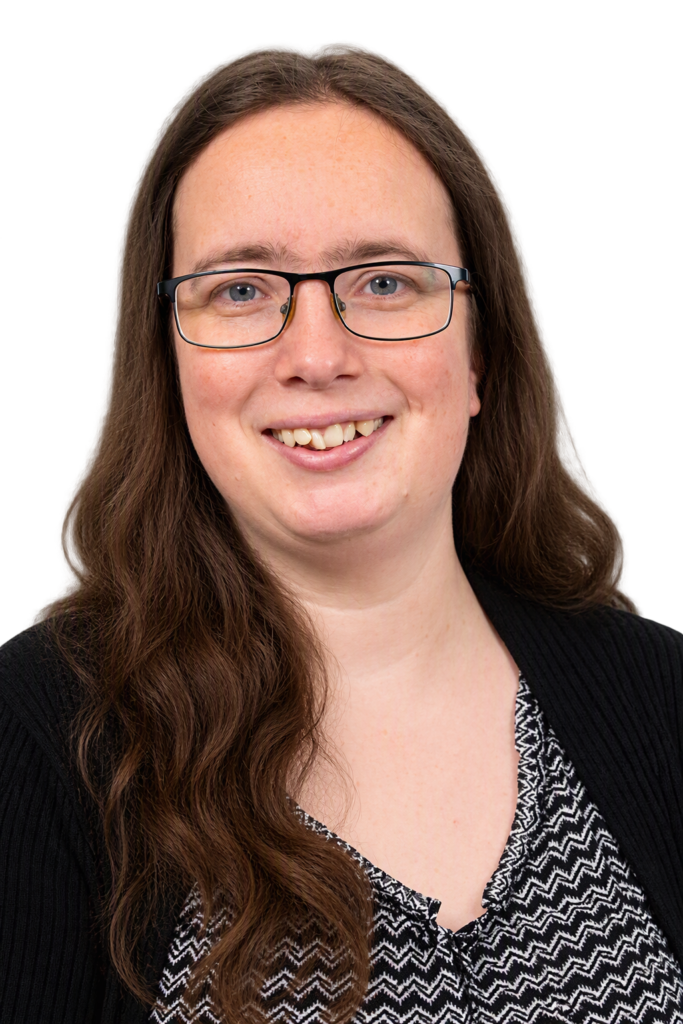
Worthwhile work
How will an individual patient response to a certain treatment? To answer that question, data scientist Rachel Cavill from Maastricht University dives deep into biological big data. ‘We have only scratched the surface of what can be learned from experimental data.’
How and when did you become interested in computer science?
‘We had had a computer at home since I was about four years old. I loved playing around with it, playing games and writing programmes with my dad. At secondary school, I also took a course in informatics, which I really enjoyed. For me, studying computer science at university was a no-brainer. However, because I hadn’t studied biology, chemistry or physics, I wasn’t eligible for some programmes. That’s why I went to the University of York, where I could study a combination of computer science and mathematics.’
Did you always know you would end up becoming a computer scientist?
‘My dad was a university lecturer who had never quite got round to completing his PhD. The process in England is that you defend the first version of your thesis, receive feedback and then are awarded your degree once you have satisfactorily addressed the required revisions. My dad defended his thesis but failed to revise it in time, so he was never awarded his PhD. So, when I became interested in pursuing a PhD myself during my degree, my mum in particular needed some convincing.
I have always been drawn to a career in research because I wanted to keep learning new things. I felt that academia offered more opportunities for learning than industry, so I never seriously considered a career outside academia.
As a teenager, I could have gone into either mathematics or computer science, as I enjoyed both equally. However, during my university studies, I noticed that the computer science curriculum was much more up to date and covered the latest developments in the field. In mathematics, the most modern stuff we saw was from the 1970s. Computer science therefore seemed like the safer bet, as I already knew that I would be able to keep up with the latest developments in the field.’
You obtained your PhD in an electronics department. What did it have to do with computer science?
‘The plan was for me to work on a bio-inspired topic in machine learning. On my first day, my supervisors told me to start reading about biology and see what inspired me. Since I hadn’t studied biology in high school, I started with school biology textbooks and gradually worked my way up to scientific review papers.
My PhD ultimately focused on designing programming systems based on genetic algorithms. At the time, biologists were beginning to generate large amounts of data from their experiments, but they didn’t know what to do with it. I saw an opportunity to help bridge that gap.’
What was your next move?
‘First, I needed to build up a track record in a field that was still emerging. I found a small, four-month project that required me to move to Scotland. It was a collaboration with a pharmaceutical company, and it allowed me to generate some initial results that I could then discuss in subsequent job interviews.
In fact, this four-month project led to me completing my first postdoctoral project just two weeks before defending my PhD thesis. Immediately afterwards, I secured a position at the prestigious Imperial College London, working on a project in the biomolecular medicine department. There, I worked alongside physicists, chemists and biologists, immersing myself in this new field and learning as much as I could.
The project focused on predicting whether a compound would cause cancer in humans, based on experiments conducted on human cells in Petri dishes. It was highly worthwhile work with real potential to make a difference.’
How did you end up at Maastricht University?
‘The project at Imperial College was part of a European research project coordinated by Maastricht University. After one of our annual meetings, I found myself in a café with a professor from Maastricht. I told him that I was interested in job opportunities in Europe and asked whether he could help me.
I didn’t hear anything for months, until he contacted me to say that there were two vacancies in Maastricht. I applied and was appointed to a four-year position in the medical faculty. During that time, a permanent position opened up in the Department of Advanced Computing Sciences, where I have been working as an assistant professor since 2015.’
Are there enough awards for computer science? Should we be doing more? Which awards are available? Who is eligible to nominate candidates, and when are the deadlines? Please get in touch if you would like to contribute to our efforts!’

What is your research about?
‘Broadly speaking, I am interested in what we can predict from molecular data. My research focuses on two main areas: data integration and interpretability, or explainability. How can we meaningfully combine multiple datasets relating to the same disease? What can we predict from the combined data, and how can we explain those predictions?
Identifying a set of a thousand genes involved in a particular process is not necessarily useful in itself. However, if I can explain why two groups of patients respond differently to a particular treatment, that is information a biologist or clinician can use to determine the next steps.
I take on new collaborations whenever opportunities arise. For example, I have worked with a dermatologist on the early detection of basal cell carcinomas, with pathologists on identifying regions of interest in medical images, and with paediatricians on detecting early-onset asthma in the breath of very young children.
Although my research spans a wide range of applications, it is all ultimately aimed at advancing precision medicine.’
What can a data scientist bring to this field?
‘My job is to analyse different datasets and generate hypotheses that my collaborators in biology can then test through new experiments or by examining independent cohorts to see whether the same patterns occur.
There is currently a great deal of interest in identifying disease subtypes. Does the same disease manifest itself through different symptoms, molecular profiles or imaging characteristics? By answering these questions, we can identify clinically relevant groups of patients who may respond similarly to a particular treatment.
There is a saying in pharmacology that most drugs don’t work for most people. To improve healthcare, we need to find ways to understand why a treatment works for one person but not another. That is where my research comes in.’
What are the biggest challenges in your field of research?
‘The first is communication, which remains tough. The same terms can mean different things in different disciplines, so you have to learn to spot those.
The second is data reusability. We often have to deal with batch effects: samples collected on the same day by the same people may be more similar to one another than samples from an otherwise identical experiment conducted on a different day. Researchers usually prefer to take measurements under as many different conditions as possible. However, we could gain much more by having different people conduct exactly the same experiment at different times and locations, and then comparing the results.
The data biologists collect in a week can keep data scientists busy for a year. Researchers often don’t realise just how much information their data contains. Over the past ten to twenty years, we have only scratched the surface of what can be learned from it. Given the investment required to collect these datasets in the first place, we should make sure we extract as much information as possible from them.
’You are a member of IPN’s Prizes & Awards working group. How did you get involved?
‘I had been a member of IPN for some time, representing Maastricht University at IPN meetings. During one of these meetings, we discussed why computer scientists in general receive fewer nominations for prizes and awards, and win fewer of them, than researchers in other fields of a comparable size.
We decided to establish a working group to raise the profile of our researchers and their work. We started by taking stock of the situation. Are there enough awards for computer science? Should we be doing more? Which awards are available? Who is eligible to nominate candidates, and when are the deadlines?
The next step is to identify who is eligible for nomination. To that end, we want to expand the working group to include representatives from all Dutch universities and knowledge institutes with a computer science department. That is why I would like to end with a heartfelt call to action: Please get in touch if you would like to contribute to our efforts!’