
Bringing touch to the digital world
Researchers at TU Delft’s Haptic Interface Technology Lab are developing technologies that allow people touch the digital world as naturally as the physical one.
Imagine placing your hand on your phone’s screen and feeling the touch of a loved one on the other side of the world. It may sound like science fiction, but for TU Delft associate professor Yasemin Vardar, it is a powerful motivation. Having lived far from her family in Turkey for half of her life, she wants to make digital communication not only visible and audible, but also tangible.
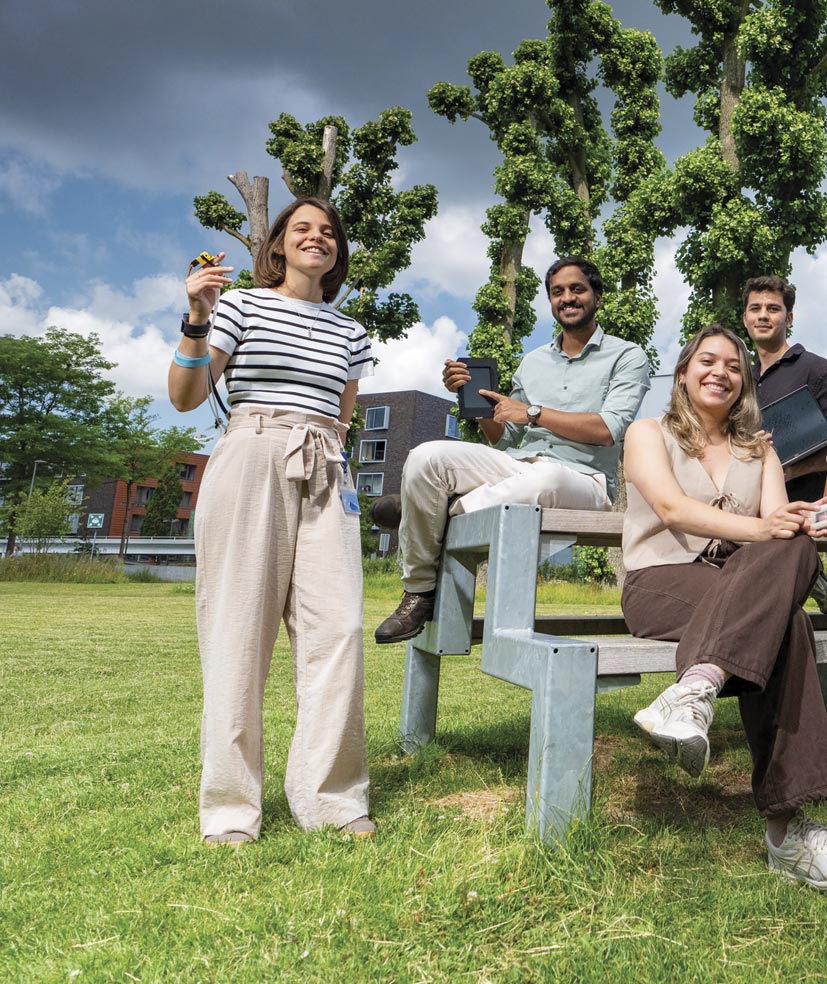
Vardar founded the Haptic Interface Technology Lab in 2020 and now leads a team of five PhD students and two master’s students. ‘Our research has two main goals’, she says. ‘The first one is to understand how humans perceive their surroundings through their skin. The second one is how we can translate this touch information in the digital world.’
Unlike vision and hearing, touch is inherently multimodal. Our skin simultaneously senses pressure, vibration, temperature, friction and stretch. That complexity has made touch much harder to digitise than images or sound. However, over the past six years, Vardar’s group has achieved several breakthroughs, which even resulted in a patent application. ‘We developed different types of multimodal haptic devices, including a pen, a screen and a ring. They can render several tactile sensations at once, including pressure, vibration, friction and temperature.’
Another of the group’s achievements is an algorithm for perceptually lossless texture compression. Much like JPEG compression reduces an image file while preserving its perceived quality, the algorithm compresses tactile information. ‘The result is a much simpler digital representation that still feels identical to the original texture’, Vardar says.
Digitising touch has a wide range of potential applications. ‘What really motivates me is communication in social settings,’ says Vardar. ‘Adding touch will allow us to convey more emotion. In healthcare, realistic haptic feedback could improve medical training and telemedicine by allowing clinicians to interact with lifelike virtual tissues. Education could also benefit, enabling students to literally feel physical concepts, for example. Other applications include tactile feedback for car and aircraft cockpits, an area in which we are actively collaborating.’
In 2025, Vardar was awarded an ERC Starting Grant to push haptic technology even further by transforming everyday surfaces, such as tables, walls and fabrics, into interactive interfaces.
Sensing texture
Jagan K Balasubramanian was doing his master’s research on haptic technology in Chennai, India, when he came across scientific papers by Yasemin Vardar. Fascinated by her work, he contacted her about a possible PhD position. He became the first PhD student to join the HIT Lab and, now in the fourth year of his PhD, also serves as the lab coordinator, helping to keep the experimental equipment in order.
His own research seeks to identify the fundamental building blocks of the sensation of roughness and friction, just like red, green and blue are the building blocks from which our eyes perceive all colours. ‘We have developed an initial model with only two parameters,’ says Balasubramanian. ‘Using these two parameters, we can represent most textures. We tested the model on five different materials, ranging from paper and wood to plastic and rubber.’
One remaining challenge, however, is that some textures cannot be represented by just two parameters. Balasubramanian is therefore refining the model to capture these differences better. ‘We may need more than two parameters’, he says, ‘but we still want to find the minimum number required to recreate the sensation of a texture. Keeping that number as low as possible is crucial for efficiently storing, transmitting, and creating new synthetic digital touch information.’
Hardware for healthcare
Paulina Gallego joined the HITLab as a PhD student in February 2026. While Balasubramanian focuses on the software needed to recreate tactile sensations, Gallego is developing the hardware. ‘My goal is to create a wearable device that can reproduce the feeling of touch on any surface,’ Gallego says. ‘Imagine you are shopping for a dress on your phone. While using the device, you touch the image on the screen and can actually feel what the fabric is like. Previously, a ring was developed in the lab, but that was not precise or portable enough for this goal.’
Although virtual shopping is an appealing application, her greatest motivation lies elsewhere. ‘I have always been drawn to working for what others need’, Gallego says. ‘Ultimately, I hope the wearable haptic device can contribute to different types of applications, such as sensory rehabilitation after a stroke. Some patients experience difficulties interpreting the tactile properties of objects, even when they can still perform the required movements. By selectively rendering or enhancing cues such as friction, softness and temperature during interactions with everyday objects, the device could support personalised tactile training.’
Through experiments with human participants, Gallego will build on other research conducted in the HITLab to investigate how people perceive materials, which sensations are essential to reproduce, and how these sensations interact. Those insights will guide the design of wearable haptic devices that bring the sense of touch into the digital world.
Group passport
Research fields
- SURFACE HAPTICS, TACTILE PERCEPTION & DIGITISATION, WEARABLE HAPTICS & SENSING FOR EXTENDED REALITY (VR, AR)
Institution
- DEPARTMENT OF COGNITIVE ROBOTICS, FACULTY OF MECHANICAL ENGINEERING, TU DELFT
Employees: Total 8 as (of September 2026)
- 1 ASSOCIATE PROFESSOR 5 PHD STUDENTS 2 MASTER’S STUDENTS
Websites
Published in I/O Magazine #2 2026
Text Bennie Mols
Images Ivar Pel