
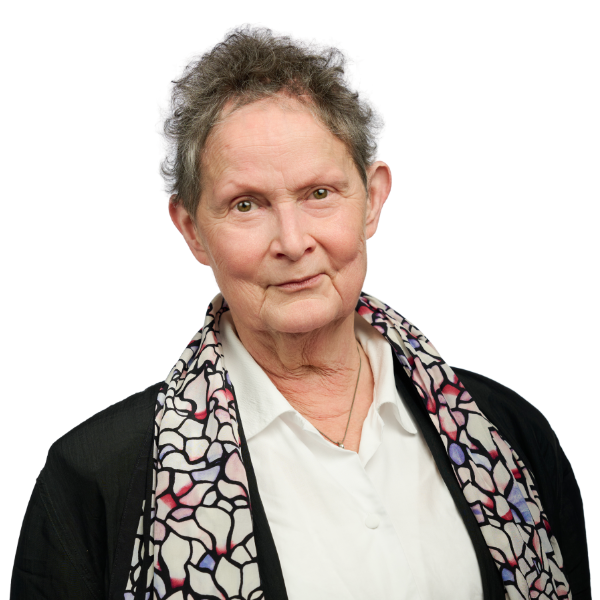
Passionate pioneer
During her decades-long career, Frances Brazier has acted as a pioneer on many levels. Whether it is about being among the first to build software agents, connecting our country to internet, or improving the position of women in STEM, Brazier is clear: ‘My career has been a very diverse, wonderful journey. That has not been the result of deliberate planning, but of following what fascinated me.’
In an interview about her work, Frances Brazier, who recently gave her valedictory speech at TU Delft, repeatedly emphasizes that in everything she does and did, she strives to follow her curiosity. ‘Whenever something fascinates me, I go for it, whether that concerns Computer Science, a cognitive phenomenon, or the legal status of software agents.’
Diverse path
This basic attitude has taken the emerita Professor of Engineering Systems Foundations on a unique and very diverse path. Her headstrong approach to building her career already showed during her studies in Mathematics at VU University, where, next to her major in Computer Science, she was the first to choose a minor in Cognitive Psychology. ‘During one of my Computer Science classes, a guest lecturer came in and started talking about Artificial Intelligence. That lecture triggered me to learn more about how thinking and learning actually work.’
Broad mindset
In her Psychology minor, Brazier was taught a completely different way of thinking. ‘Though I found it challenging – the books were a lot longer than the ones I was used to and during exams I could come up with three different answers to each and every question – I found this minor super interesting.’ Brazier ended up being offered a job in the Psychology department as a scientific programmer, where one of her tasks was to build a network of computer terminals in various primary schools. ‘Soon in, I told my supervisor that I wanted to pursue a PhD. “But in what field?”, he asked. On the spot, I came up with the topic of how people search for information, extending existing research in the department.’
Founding the Dutch internet
Through her work, Brazier came into contact with people from different institutions with whom she wished to collaborate. ‘We were looking for an easy way to exchange documents for research purposes. Since we had the technology to connect individual terminals, we as members of the NLUUG (the Dutch UNIX User Group), started to expand this connectivity. The number of users grew explosively. At the time, we were not allowed to send data over telephone lines, unless if that took place within an association. And that is how NLnet was born.’ NLnet ended up becoming the first commercial internet provider, playing a crucial role in the launch of the Internet in the Netherlands and Europe.
‘I was 30 when I became involved in setting up what became the Dutch internet with NLnet, and 40 when I sat down with people from World Online to negotiate a multimillion takeover,’ Brazier looks back on this adventure of a lifetime. She herself is not that impressed with this achievement though. ‘To us, NLnet was more a means to an end. Essentially, the Dutch Internet arose from our need for a way to make information exchange easier.’
Means to an end
It is a way of working that characterizes the energetic researcher. As soon as a problem has captivated her, she starts looking for solutions. And if that requires setting up an association and delving into business models, so be it. ‘NLnet started as an adventure and didn’t feel like work. But still, my working days begun at 7 a.m. and I often didn’t get home until 10 p.m… including weekends. Ultimately, science is about doing something that energizes you. If having a certain job or title helps, embrace the challenge. Positions are a means to an end, not a goal in themselves.’
Frances Brazier studied Mathematics, Computer Science, and Cognitive Psychology at VU University, earning an MSc in 1983, and completing a doctorate in 1991. She became an assistant professor at VU Amsterdam in 1991, an associate professor in 1998, and professor in the chair of Intelligent Interactive Distributed Systems in 2000. Brazier moved to TU Delft in 2009, where she held the chair of Systems Engineering Foundations until May 2024.

Autonomous systems
It will not come as a surprise that during her research career Brazier has worked on a vast variety of topics, ranging from software agents to social value systems, and from transport logistics to adapting aircrafts. In her valedictory speech, she summarized her work as ‘Designing participatory systems’. The golden thread is formed by the question how groups work together, she explains. ‘Throughout the years, I mainly worked on groups of (human and non-human) autonomous systems. How do you design software agents and their interaction with other software agents and with human agents? How do you design a system so that human agents can take responsibility for the result of such interaction? How can agents organize themselves at a local level to achieve global results? How do you translate your hybrid solutions to applications in the real world?’
Determine own direction
If anything, Brazier can be qualified as an explorer of unknown territories, and a driver of innovations. ‘When something becomes commonplace, the challenge diminishes,’ she shrugs. Her motto to ‘follow your research heart’ is also the main message she has instilled in her many students. ‘My PhD students usually end up diverging from the original plan,’ she says with a laugh. ‘And that is fine. It’s my job to inspire them and gauge their interests. Ultimately, they have to determine their own direction in research, and in life.’
Women in science
Being one of the first female Computer Science professors in the Netherlands, Brazier has always been committed to improving the position of women in science, among other things as chair of the LNHV (Dutch Network of Women Professors). ‘Today, at least there is awareness, also across Executive Boards of universities, that there is an issue with gender diversity. That does not mean that the problem has been resolved though. If you look at how many female students become full professors, it is still saddening. Fortunately, we are seeing an increasing number of men who are committing themselves to this cause, which is encouraging.’
Leading the way
When the LNHV started to issue its annual monitor, only Malta had a lower percentage of female professors than the Netherlands, Brazier says. ‘Over the years, we have started to climb that ladder, but not very quickly. If there is one field where you have the freedom to be flexible in your working hours and combine a job and a family, it is in Science. So, if anything, as scientists we should be leading the way when it comes to emancipation.’
Even though she has formally retired, Brazier is still full of plans. ‘There is still so much to learn! I am still supervising six PhD students, am a member of several advisory committees, and I act as a coach for a number of people. Besides that, I am slowly taking on new projects, but only things that interest me and where I can make a difference. Here in my neighborhood, high school students know that they can come to me if they have trouble learning Math: I love teaching. The only requirement I have is that they do their best.’
She concludes: ‘Life consists of choices, but you have to either see or create them. Do you accept the downfalls of a given system, or do you try to change it for the better? It is in my nature to always go for the latter option.’
Photo: Sjoerd van der Hucht