
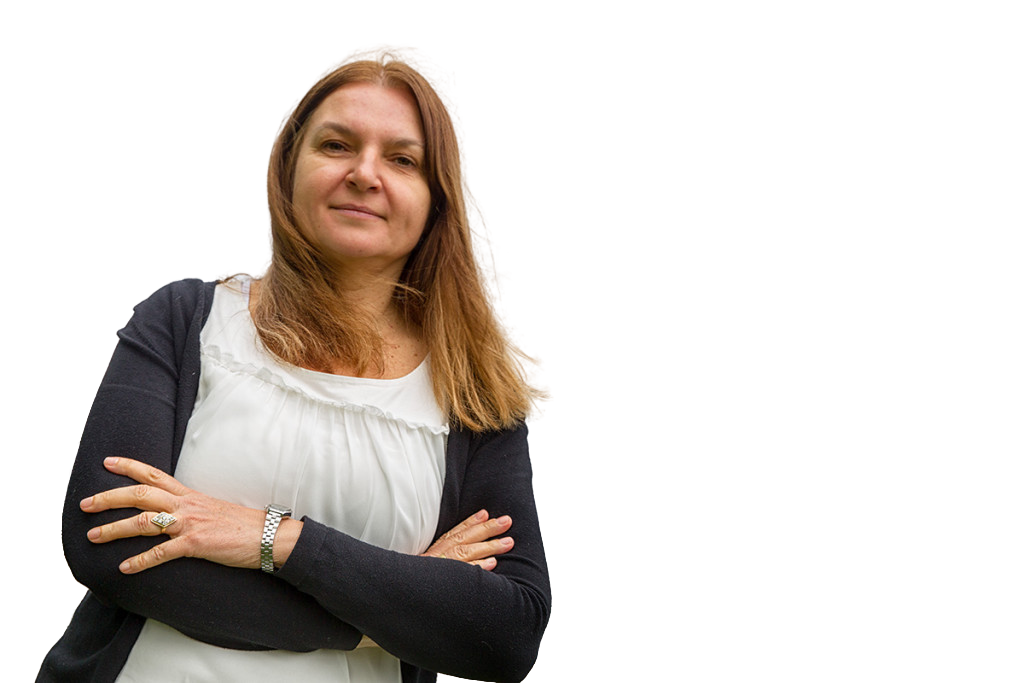
‘Being a scientist is the best job in the world’
The career path Lejla Batina followed to end up as a Professor of Security of Small devices at Radboud University is not that standard. Along the way, she gained knowledge about and experience in a vast amount of topics and disciplines, ranging from designing hardware for cryptographic chips to using artificial intelligence to find the best way to hack into bank cards.
You obtained an MSc in mathematics. How did you end up in informatics?
‘Since I had always loved mathematics and had even attended a special high school focused on the topic, it was quite a natural choice for me to enrol in a mathematics course program at university. However, in Croatia, where I come from, the only job one would get with that education, was high school teacher. My parents weren’t that happy with my choice. They thought I had better become an architect or a medical doctor. Then the opportunity came along to go to Eindhoven and study mathematics for industry as a post-master program, resulting in what is now called an EngD (Engineering Doctorate) degree. That was a nice way for me to advance my studies in maths and at the same time prepare for a job in industry. During that program, I chose the stream on information and communication technology. I immediately liked it, since to me, informatics initially felt a lot like applied mathematics.’
How did you end up in science from there?
‘After I completed the mathematics for industry program, I started working for a company called Pijnenburg Securealink. While at that company, I was doing research and publishing papers. My boss at the time suggested that I might just as well pursue a PhD. That is why I joined KU Leuven as an external PhD student. Unfortunately, when the company was taken over by an American enterprise, I was supposed to stick to coding alone, so continuing my PhD would not be possible. Since that didn’t suit my interests, I transferred to academia fully. The nice thing is that through my initial experience in industry, I now have quite an extensive network. This helps me acquire projects funded by the NWO domain Applied and Engineering Sciences, since they require you to set up user committees of industrial partners that are interested in your academic work.’
What is it that you like most about working in academia?
‘The freedom it provides you with to follow your own interests. I have always believed in delving into the topics that are not only scientifically challenging, but also of interest to companies, since that enables me to make an impact on the real world. Honestly, I do not see any disadvantages of being a scientist. To me, it still is the best job in the world.’
What is your research about?
‘My research interests are in applied cryptography and embedded systems security. I am looking into security and privacy of embedded devices such as smartcards, mobile phones and Internet-of-Things devices. One of the challenges in developing cyber security solutions for these types of small devices is that typically, you do not have that much computing or battery power. So, you have to come up with algorithms that do the job in securing information and communication, but are also fast, preferably cheap, and energy and computation efficient.
During my time in industry, I was focusing on hardware design for cryptography; designing chips that run cryptography algorithms. After my PhD, I expanded into the topic of side channel attacks. By measuring physical properties like energy consumption or voltages, you can find ways to break the algorithms that are running on some device. It’s often the mathematics that is secure, but the physics where the leaking begins.’
Lejla Batina is a full professor of Security of Small devices in the Digital Security group of Radboud University, and adjunct professor at the Selmer Center of University of Bergen in Norway. Before she joined Radboud University in August 2009, she was a postdoc at KU Leuven in Belgium where she also obtained her PhD in 2005. Before that, she worked as a cryptographer for Pijnenburg Securealink and got a Professional Doctorate in Engineering from TU Eindhoven in 2001. Batina holds an MSc degree in Mathematics from the University of Zagreb, Croatia.

What kinds of topics are you currently working on?
‘Lately, a lot of my work has been focused on so-called post-quantum cryptography. This is a new class of algorithms that should be able to withstand a quantum computer. Whether such a quantum computer will ever exist or not, this class of cryptography is now in full development to secure our communications in the future.
In my group, we are working on the development of new hardware for post-quantum cryptography as part of a national Gravitation program called Challenges in Cyber Security.
A second topic I am looking into has to do with fault injection. There are cases in which one fault can break an algorithm completely. We consider different types of algorithms to pinpoint which are favourable to use because they are either easy to secure or prevent faults from propagating further.
Finally, I am increasingly engaging in research involving artificial intelligence in different ways. For example, in 2019, together with colleagues in Singapore we did the first work ever on attacking AI via side channels and finding the underlying weights and biases that are usually part of the intellectual property of such a model. But we also use new AI techniques to first develop the best possible attacks and then the protectional algorithms.’
Recently, you became the new chair of IPN’s Special Interest Group Cyber Security. What do you hope to achieve in that position?
‘When the previous chair Marten van Dijk stepped down and I was asked to become his successor, that was a natural step for me. Since I am also representing the cyber security community in NWO’s Round Table Computer Science, I see ample possibilities for cross-pollination. I think it is good for our community to stay in touch with funding agencies to both understand what is happening in research policy, and influence it.
To name an example: at the Round Table, we noticed that computer science does not do well in terms of amount of granted projects. We analysed the numbers. One conclusion was that the sector is not at all doing bad in the reviews, but that computer scientists just send in a lot less applications than other disciplines. That helps us in educating our colleagues about how to increase the amount of funding flowing into our field.’
In that regard, do you have an advice you would like to share?
‘Most of the career choices I made can be traced down to the message instilled upon me by my parents: If you do not step up, you will never reach your full potential. That is also why I always advise my students to not stay in their comfort zone, but instead collaborate with people from other fields and keep learning new things. That keeps you on your toes, and frankly, also keeps your work interesting. Whenever I am confronted with a new question or challenge, my first reaction almost always is to say “Yes, let’s try and see how far we’ll come”.’