
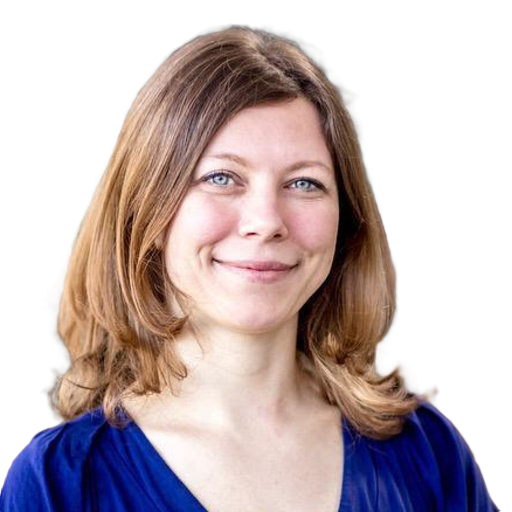
Capturing relationships
From energy grids and stock returns to brain fMRI’s and body measurements: Associate Professor Çiçek Güven from Tilburg University sees relationships in everything. With her expertise in network analysis and learning on graph-structured data, she loves working on data science projects with a social aspect.
How did you end up in computer science?
‘I always wanted to be a scientist. When I was a child, my parents had subscriptions to various science and technology magazines. From an early age, I could follow the material and I found myself immersed in the stories, which stimulated my curiosity. To me, scientists were problem solvers. Although I did not yet have a technical understanding of how computers worked, I was already drawn to them and began considering a future in computer engineering.
Since I liked Mathematics in high school that was the natural choice for me when the time came to decide which study program to enrol in. My PhD research was also focused on abstract math, albeit in the context of a combined Mathematics and Computer Science department of a technical university. After having worked in industry for four years, I returned to academia for an interesting data science-oriented postdoc position. And I have been working as a scientist ever since.’
Despite becoming a scientist being your childhood dream, you did spend some time working in industry. How did that come about?
‘When I was finalizing my PhD thesis, I was approached by a head-hunter who offered me a job as a quant (quantitative analyst, ed) in the banking sector. I thought it would be good to get a flavour of what it feels like to work in industry. As a quant, I worked with a team where most members held PhDs, which made the environment highly stimulating. Later, I took up a position as a data analyst in consultancy. At that time, data science was just emerging as a field, and I thought it would be good to gain some experience with it. That worked out well: during that time I was able to further develop my existing skills and acquire new ones, particularly in programming and machine learning. And those came in handy when I returned to academia.’
What is your research about?
‘In general, I work on topics involving relational data and graph learning; it is my firm belief that the world is best represented in terms of relationships. I am interested in understanding networks: how do they change, what meaningful substructures do they have, and how does that relate to implementing and understanding machine learning approaches on graphs. Over the years, I have worked on relational representations in a variety of application areas like electricity grids, brain networks, and more recently, I have been exploring knowledge graphs of text. For example, we are developing a network-based approach to analyse brain data, aiming to investigate the relationship between brain characteristics and poverty through a relational representation. In this interdisciplinary project, the workpackage I am responsible for focuses on applying graph representation learning methods to the data to uncover the link between poverty and cognitive processes.
Not all projects adopt a network-based approach though. Another interesting collaboration was with the Zero Hunger Lab here in Tilburg. They are working with an NGO to measure malnutrition from images. In this project, the primary focus was a computer vision task. It also involved an ethically and responsibly conducted data collection effort as no public datasets of lightly dressed children are available, for understandable reasons.’
‘I regard IPN to be a unifier and facilitator. I feel there is a strong shared mission to create a better future for younger researchers. In addition, I experience a strong culture of mentoring, for example by advertising grants for postdocs and organising leadership programmes to prepare people to take up bigger roles in the scientific community and beyond.’

Besides your own research, you have taken up a multitude of managerial tasks, ranging from managing the ILLUSTRE ICAI lab at Tilburg University, taking part in the management team of your department, and chairing the Lorentz Center Informatics Board, to co-chairing the Equity, Diversity and Inclusion working group of IPN. Why do you engage in these types of activities?
‘I cannot detach myself from the environment I am in. And I am a person of communication and dialogue, who always shares her thoughts on matters, whether solicited or not. So, besides the fact that I feel a responsibility to create opportunities for younger scientists, getting involved in research management also is a natural thing for me to do. In the end, I want to help build a sustainable scientific environment where people can thrive.’ What is your ambition as a co-chair of the EDI working group?
‘Overall, we want to improve the presence of minorities, ranging from women to people from the LGBTQIA+ community. What are the problems these minorities face in academia, and how can we address these? To this end, we for example host a dedicated track at ICT.OPEN every year. The topic of diversity and inclusion is always in the back of my mind. In our school here in Tilburg I act as the diversity and inclusion officer who is responsible for the diversity related topics concerning employees. I also participate in the Inclusive Classroom special interest group at the university level, where attending to the needs of neurodiverse students is a recent and active area of focus.
Some time ago, it occurred to me that as data scientists we are also contributing through our science, bridging ideas and implementation, so I contacted some colleagues and together we documented an accessible synthesis of existing work and initiatives in AI for diversity and inclusion. The outcome, which provides insights over how a research centre operationalises on D&I topics, has been issued as a white paper and can be found online. To me, it all starts with sharing our perspectives, showing our position and inspire others to think about this topic.’
What are your thoughts about IPN as a whole?
‘I regard IPN to be a unifier and facilitator. I feel there is a strong shared mission to create a better future for younger researchers. In addition, I experience a strong culture of mentoring, for example by advertising grants for postdocs and organising leadership programmes to prepare people to take up bigger roles in the scientific community and beyond.
That is a role that I strongly support. In the end, it is primarily by contributing to the overall progress of since and creating opportunities for others that your legacy will persist.’